| |
|
| Change fork reb target |
|
|
| |
|
 |
|
| |
| |
- 5-4-23 Use .47 x 2 = .94 kg fk spr for all comparisons (we were using .96).
- However, this small change is spring rate is minimal and only changes reb force by .20 lbs .96 kg = -19.2 .94 kg = -19.0
- So if we forget to change it somewhere it won't make that much difference.
- We compute dyno rebound force and reverse engineered rebound force using r-zeta values throughout the dyno test velocity range.
- e.g. 1ips, 2ips, 3ips, 4ips . . . 70ips
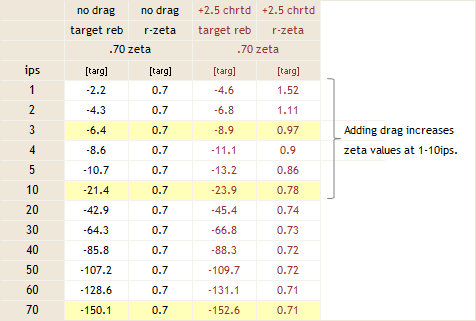
- r-zeta was intended to be .70 throughout the range. However, we found that zeta values at 1-5 ips will always be higher due to fork seal and bushing drag.
- This phenomena is found on all forks and is inherent in the mv piston design and shim stack configurations. It's physically impossible to get reb force and r-zeta down at 1-5ips without major tweaking and manipulation that goes far beyond the norm.
- We dyno and pressure test the fork cartridge and the dyno numbers have cartridge drag, but no seal or bushing drag.
- To compensate we add 2.5 lbs drag force to each fork leg before computing zeta.
- Example of .70 r-zeta from 1-70ips.
-
- -
- It's accepted that zeta is high at 1-5ips. Usually by 10-20ips r-zeta is closer to the desired .70.
- -
- We have created rebound targets that account for seal drag.
- Example of .70 r-zeta vs. target .52-.70s.
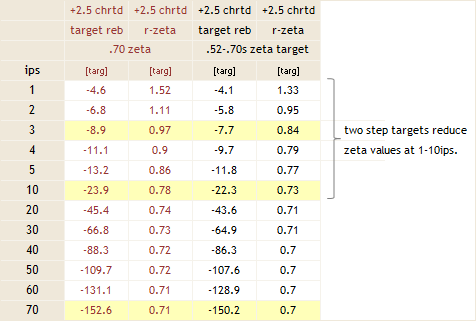 - -
- The first number in the target is nondescript and simply indicates r-zeta is less at 1-10ips. The lower the number the greater the reduction in the zeta value.
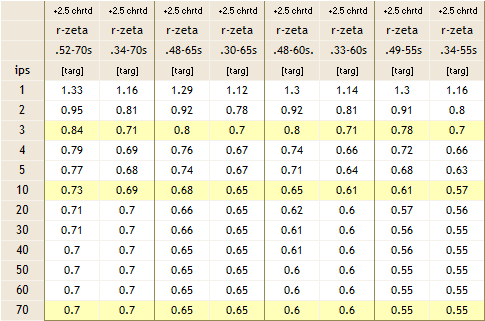
- Sample r-zeta targets.
- .52-.70s .34-.70s .48-.65s .30-65s .48-60s .33-60s
 - -
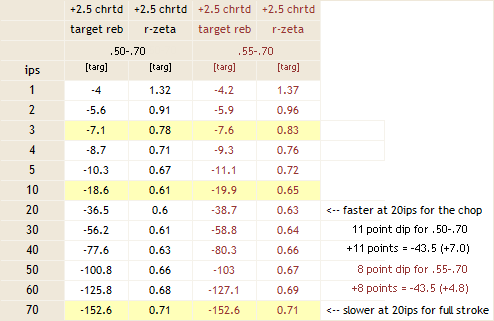
- A rocks and roots Enduro setup may work better if rebound is faster at 20ips to work the chop, then is slower at full stroke velocities of 70ips to keep the bike stable.
- Targets .50-.70 and .55-.70 dips in the middle.
- Use the r-zeta factor to to adjust values as needed.
- For example, target .50-.70 x .90 gives zeta values of .54 at 20ips and .64 at 70ips.
 - -
- CONCLUSION
- It's definately an advantage to have a preconceived idea of rebound before building the fork. With experience, the targets allow you to choose the best 'current thinking' rebound for each application. Then adjust as needed.
|
| |
|